
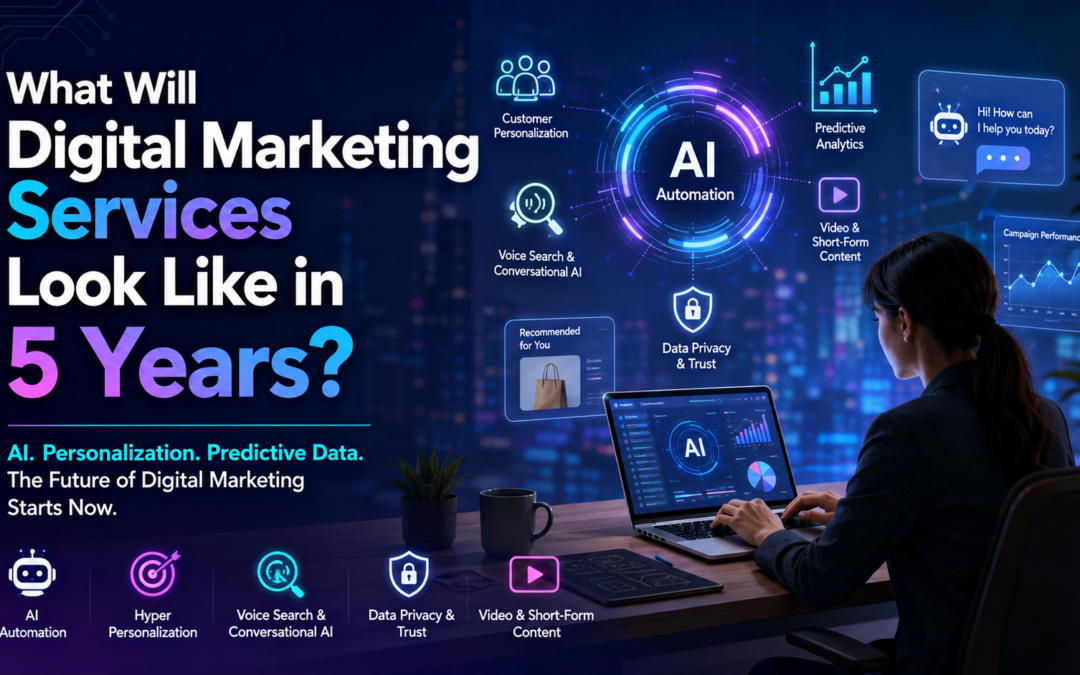
In the next five years, digital marketing will run on AI-driven automation, real-time personalization, and predictive data instead of guesswork. Brands that adopt AI tools early will save time, cut costs, and reach customers faster than those using old-school methods. Businesses searching for the best AI digital marketing service in Velachery are already preparing for this shift by combining human creativity with smart automation.
Digital marketing has changed more in the last five years than in the previous twenty. Look at the next five years, and the pace will only pick up. If you run a business, or work in marketing, you need to know what’s coming. This guide breaks it down in plain language.

Contents
- 1 Why Digital Marketing Is Changing So Fast
- 2 1. AI Will Run Most Daily Marketing Tasks
- 3 2. Search Engines Will Answer Questions, Not Just List Links
- 4 3. Personalization Will Become the Default, Not a Bonus
- 5 4. Voice Search and Conversational Queries Will Grow
- 6 5. Data Privacy Will Reshape How Brands Collect Information
- 7 6. Video and Short-Form Content Will Dominate Even More
- 8 7. Marketing Teams Will Need New Skills
- 9 How Businesses Can Prepare Now
- 10 Final Thoughts
- 11 Frequently Asked Questions
Why Digital Marketing Is Changing So Fast
Three things are driving this change: artificial intelligence, changing customer habits, and stricter data privacy rules. Customers now expect quick, personal, and honest communication from brands. Search engines reward useful content over keyword stuffing. And AI tools can now do tasks that used to take a full team.
This isn’t a small shift. It’s a full reset of how marketing works.
1. AI Will Run Most Daily Marketing Tasks
Right now, marketers spend hours writing ad copy, scheduling posts, and checking analytics. In five years, AI tools will handle most of this automatically.
What This Means for Businesses
- Ad campaigns will adjust themselves based on live performance data.
- Content ideas will be generated and tested in minutes, not days.
- Customer replies on chat and social media will be handled by smart bots that sound human.
This doesn’t mean marketers disappear. It means their job shifts from doing repetitive tasks to guiding strategy and checking that AI output stays honest and on-brand. Many local businesses already search for the best AI digital marketing service in Velachery to get this exact mix of automation and human oversight.
2. Search Engines Will Answer Questions, Not Just List Links
Google’s AI-driven search, along with tools like ChatGPT, Perplexity, and Gemini, now gives direct answers instead of just showing website links. This is called answer engine optimization, or AEO.
How Marketing Content Will Adapt
- Content will need clear, direct answers near the top, just like this guide.
- Long, fluffy articles will lose ranking power.
- Structured data and FAQs will matter more than ever.
Brands that write helpful, honest content will win. Brands that stuff keywords without real value will fall behind, no matter how big their budget is.
3. Personalization Will Become the Default, Not a Bonus
Right now, personalization means adding a customer’s first name to an email. In five years, it will mean showing each customer a different version of a website, ad, or offer based on their exact behavior.
Real Examples of This Shift
- An online store showing different homepage banners to a first-time visitor versus a repeat buyer.
- Email subject lines that change based on what a customer clicked last time.
- Ads that stop showing once a customer has already purchased, saving budget.
This level of personalization needs strong data systems. Small businesses without in-house tech teams will lean on specialized agencies to set this up correctly.
4. Voice Search and Conversational Queries Will Grow
More people are asking questions out loud to their phones, smart speakers, and AI assistants instead of typing. This changes how content must be written.
What Voice-Friendly Content Looks Like
- Short, natural sentences that sound like real speech.
- Clear answers to common questions, placed early in the content.
- Local keywords, like a service name plus an area, since many voice searches are location-based.
This is exactly why phrases like “best AI digital marketing service in Velachery” matter. People now speak these full phrases into their phones instead of typing short keywords.
5. Data Privacy Will Reshape How Brands Collect Information
Third-party cookies are going away. Data privacy laws are getting stricter across the world. This means brands can no longer track customers everywhere they go online.
What Marketers Will Do Instead
- Collect first-party data directly, through sign-ups, surveys, and loyalty programs.
- Build trust so customers willingly share information.
- Use AI to make smart predictions from smaller, cleaner data sets instead of massive tracked data.
Brands that respect privacy will earn more trust. Trust converts to sales more reliably than aggressive tracking ever did.
6. Video and Short-Form Content Will Dominate Even More
Short videos already get more attention than text or static images. In five years, this gap will widen. AI tools will make it easy for even small businesses to produce professional video content without big budgets or film crews.
What This Means Practically
- A local shop can create a polished product video in minutes using AI editing tools.
- Live shopping videos will become common, letting customers buy while watching.
- Video search, where AI understands what’s happening inside a video, will affect rankings too.
7. Marketing Teams Will Need New Skills
As AI takes over repetitive work, human marketers will need different skills to stay valuable.
Skills That Will Matter Most
- Understanding how to guide and check AI output for accuracy and tone.
- Strong writing and storytelling, since AI can draft but not truly connect emotionally.
- Basic data literacy, to read reports and spot what AI might miss.
- Ethical judgment, to keep marketing honest and compliant with privacy laws.
Marketers who combine creativity with tech comfort will lead the field. Purely manual skills, without any tech understanding, will become harder to rely on.
How Businesses Can Prepare Now
You don’t need to wait five years to start adjusting. Small steps now make a big difference later.
- Start collecting first-party customer data through email lists and loyalty programs.
- Test AI tools for content drafts, but always add a human review step.
- Write website content that directly answers customer questions.
- Optimize for local search if you serve a specific area or city.
- Invest in short video content, even simple smartphone videos work well.
Working with a team that already understands the best AI digital marketing service in Velachery approach can save months of trial and error.
Final Thoughts
Digital marketing in five years will be faster, smarter, and more personal. AI will handle the repetitive work. Humans will handle strategy, creativity, and trust-building. Brands that blend both will win the most attention and the most customers.
The businesses that start adapting today will have a real head start when this future arrives.
Frequently Asked Questions
What will digital marketing look like in the future? Digital marketing will rely more on AI automation, real-time personalization, and direct-answer content built for search engines and AI assistants, instead of traditional keyword-based tactics.
Will AI replace digital marketers? No. AI will handle repetitive tasks like scheduling and basic content drafts. Marketers will focus on strategy, creativity, and making sure AI output stays accurate and on-brand.
How is AI changing digital marketing today? AI already helps write ad copy, analyze customer data, personalize emails, and manage chatbots. This role will expand to cover full campaign management within a few years.
What skills will digital marketers need in five years? Marketers will need data literacy, strong writing skills, the ability to guide AI tools, and a solid understanding of privacy-friendly marketing practices.
Why does local SEO still matter if AI search is growing? AI search tools often pull local business information first when a query includes a location. This makes local optimization, including clear service and area names, more important, not less.
Is voice search really changing how content is written? Yes. Voice search relies on natural, conversational phrases. Content written in short, clear sentences with direct answers performs better in voice results.